 Back to Blog
A new signup is not automatically a trusted user. It may be a real customer, a bot, a fraudster, or one person creating multiple accounts. SMS OTP verification adds a practical trust check by confirming that the person completing the flow can receive a message on the phone number they provided. That does not prove full identity, but it gives the application one useful fact it can act on. The real implementation challenge is deciding where verification belongs, how to prevent abuse of the verification flow itself, and what the app should do after a number is verified.
What SMS phone verification actually proves
Phone verification answers a narrow but important question: does this user control the phone number they entered?
That distinction matters. A successful verification does not prove a person’s legal identity, stop every type of fraud, or guarantee that one phone number always maps to one individual. What it gives you is a stronger signal than an unverified form field.
For many signup and access-control workflows, that signal is enough to be useful. It can help teams:
- reduce low-effort fake registrations;
- make bulk account creation more expensive;
- confirm a reachable contact point before activating an account;
- enforce one-number-per-action rules in voting, promotions, or gated workflows;
- add a trust step before sensitive account changes.
Treat phone verification as one layer in the application’s trust model, not as a complete authentication strategy. If the action carries higher risk, the verification result should be combined with other controls such as session checks, device signals, account history, rate limits, or manual review.
Decide where verification belongs in the signup journey
The best verification point is not always the first screen. Every verification step adds friction, so it should protect something worth protecting.
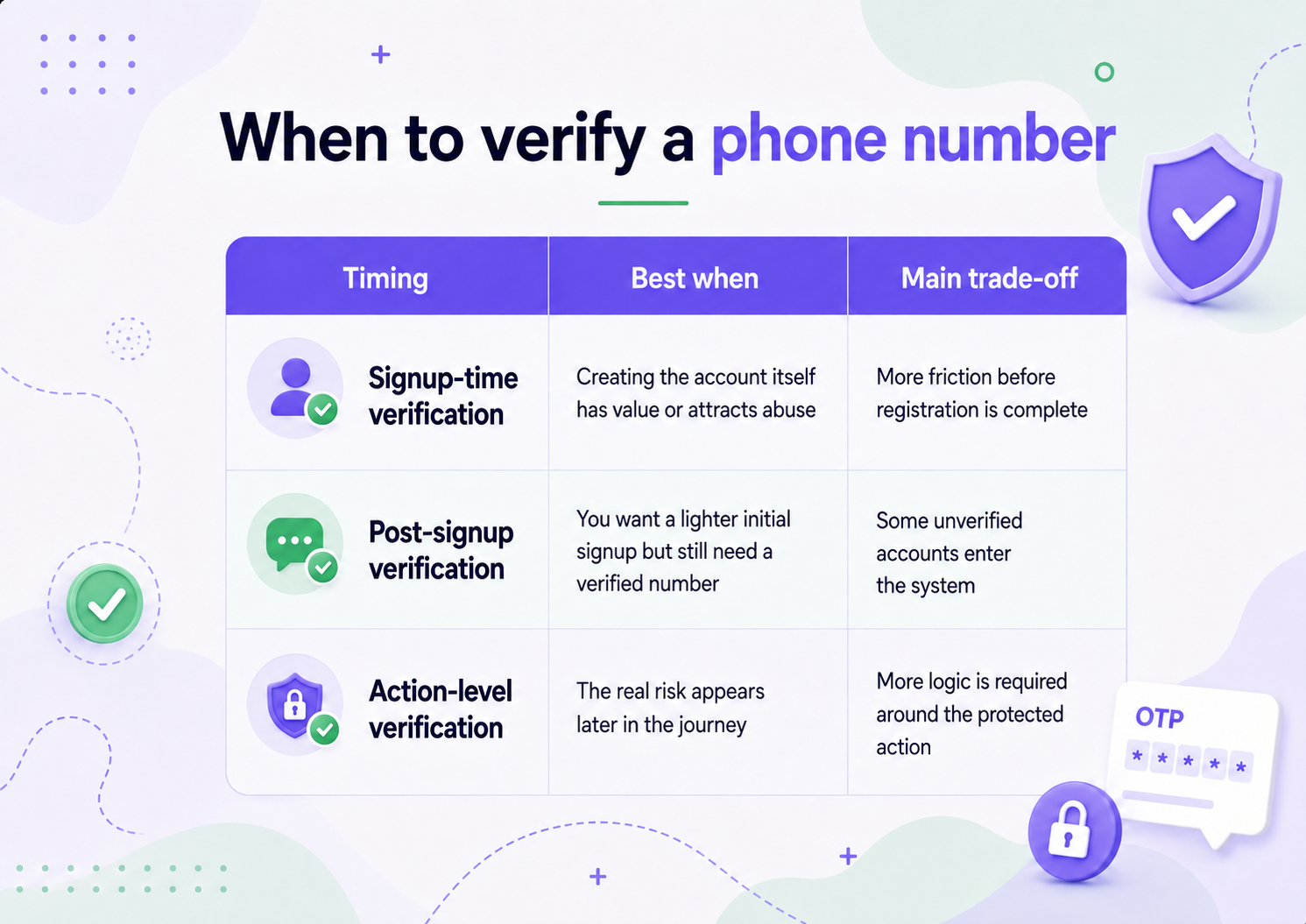
Verify early when account creation itself has value
Verifying at signup makes sense for workflows such as free trials, referral programs, limited inventory, coupon redemption, or communities where duplicate accounts create moderation problems. Confirming the number before activation can keep the user database cleaner from the start.
Delay verification when the risk appears later
Post-signup verification can work better when you want a lower-friction registration experience. The user can create an account first, but selected features remain locked until the phone number is verified.
Action-level verification is useful when the highest risk appears later. A user might browse normally, then verify before changing sensitive account details, submitting a vote, claiming a benefit, or completing another restricted action.
The right placement depends on the cost of abuse versus the cost of friction. If fake account creation is cheap for an attacker and expensive for the business, verify earlier. If most users are legitimate and the risky action happens later, delay the check until it is needed.
How an SMS OTP verification flow works
The basic OTP sequence
A standard SMS OTP verification flow is simple from the user’s perspective:
- The user enters a phone number.
- The app requests a one-time code.
- The verification service sends the code by SMS.
- The user enters the code in the app.
- The backend checks whether the code is valid and still active.
- The app records the verification result and allows the next action.
The key design choice is to keep code generation and validation on trusted server-side infrastructure. The browser or mobile client should never contain credentials that can request or verify codes directly.
The application should also normalize phone numbers before sending them into the verification flow, especially when users can sign up from multiple countries. Consistent formatting makes it easier to match future requests, enforce limits, and avoid treating the same number as multiple identities because it was entered in different formats.
OTP codes are not the only verification option
Some verification flows can send a secure verification link to the user’s phone instead of asking them to type a code.
The experience is different, but the trust question remains the same: did the person prove control of the phone number they supplied?
Choosing between an OTP and a verification link should depend on the product experience, the device context, and how much control the application needs over the confirmation step.
Design the verification flow for abuse, not only the happy path
The biggest mistake in phone verification is designing only for a legitimate user who requests one code, enters it correctly, and continues.
Attackers do not follow that path.
A verification endpoint can itself become an abuse target. Automated scripts can trigger repeated code requests, cycle through large lists of phone numbers, or make many code-entry attempts. Even when an attacker never verifies successfully, they can create messaging cost, noisy logs, support issues, and unnecessary load.
Rate-limit verification requests
Rate limiting is part of the security model, not just a technical optimization.
At minimum, define controls for:
- how often the same number can request a new code;
- how many verification requests can originate from the same account, device, session, or IP range;
- when repeated requests should trigger a cooldown;
- when suspicious behavior should be logged or reviewed.
A flow that allows unlimited verification requests can become expensive even if no attacker ever succeeds in entering a valid OTP.
Control resends and incorrect code attempts
A “Send again” button should not mean “send indefinitely.” Use a cooldown, make the user wait before another request, and avoid creating a new active verification state every time the button is clicked.
Code entry needs limits too. Define how many incorrect attempts are allowed before a temporary block, reset, or new verification request is required.
Clear error messages are useful, but they should not reveal unnecessary details that help someone test the system. Tell legitimate users whether they need to retry, request a new code, or correct the phone number without exposing internal verification rules.
Your application still owns the trust decision
A verification provider can confirm whether the code or verification link is valid. Your application still decides what that result means.
Persist the verification result
The app needs durable state. If a number was verified for account activation, record that result. If verification unlocked a one-time vote, redemption, or restricted action, record that too.
Otherwise, a user may be able to repeat the same workflow after opening a new session or after the application state is reset.
Do not store more verification data than you need, but do store enough to enforce the business rule. Depending on the use case, that may include:
- verification status;
- normalized phone number;
- verification timestamp;
- the account or action associated with the verification;
- retry or lockout state;
- audit information needed for troubleshooting.
Keep verification logic and credentials server-side
Verification credentials and service configuration should remain on trusted infrastructure.
Environment variables or an equivalent secrets-management system are appropriate; browser code, public repositories, and client-side configuration are not.
Code generation, verification checks, authorization decisions, and persistent verification state should all be handled by trusted backend logic.
It is also important to separate “phone number verified” from “user trusted.” A verified number can improve confidence, but risk can change over time. A mature application can use phone verification as one signal alongside account age, device history, unusual behavior, and the sensitivity of the requested action.
Balance security, user friction, and verification cost
A verification flow can be secure on paper and still fail in production if legitimate users cannot complete it reliably.
Tune expiry and retry rules for real users
Code expiry is a good example. A very long expiry window weakens the value of a one-time code. A very short one creates unnecessary failures when messages are delayed or users switch between apps.
The goal is a window that is short enough to limit risk but long enough for normal delivery and entry.
Retry policy creates the same trade-off. Users mistype codes. Messages can arrive late. Numbers can be entered incorrectly. A good flow allows recovery without turning retries into an unlimited attack surface.
Teams should test these failure scenarios deliberately instead of discovering them after launch.
Treat verification cost as part of the abuse model
The business model behind verification also matters because failed attempts can generate real cost.
Traditional message-based billing can make every sent verification message billable even when the user never completes the process. That means automated requests are not only a security problem; they can also become a direct cost problem.
For teams that do not want to build OTP generation, delivery, validation, and retry logic themselves, the TopMessage Verify API handles the verification lifecycle with outcome-based pricing: businesses pay for successful verifications rather than failed verification attempts.
That aligns cost more closely with the result the application actually needs.
Cost should not determine the security design, but it should be part of it. If abuse can trigger unlimited paid messages, the economics of the endpoint become part of the threat model.
Know when SMS verification is the right level of trust
SMS verification works well when the application needs a practical, familiar signal of phone-number control without introducing a heavier identity process.
It is a strong fit for:
- app signup and account activation;
- low- to medium-risk gated actions;
- duplicate-account reduction;
- promotions, voting, and one-number-per-action rules;
- contact confirmation;
- step-up checks before selected account changes.
It is a weaker fit when the application must prove legal identity, meet a higher assurance standard, or remain independent of mobile message delivery. In those cases, SMS verification may still be one layer, but it should not be the only one.
The decision should start with the business risk. Ask what you actually need to know about the user.
If control of a phone number is enough to reduce the abuse you care about, SMS OTP verification is often a reasonable control. If the action requires stronger proof of identity, stronger methods are needed.
SMS OTP verification implementation checklist
Before launch, confirm that the team has made explicit decisions about both the happy path and the abuse path:
- define exactly what triggers verification;
- decide what successful verification unlocks;
- normalize phone numbers consistently;
- keep code requests and validation on the server;
- keep credentials out of client-side code;
- set code expiry rules;
- set resend cooldowns and request limits;
- limit incorrect code attempts;
- define temporary blocking or review behavior for suspicious activity;
- persist verification state and the action it authorized;
- test expired, delayed, incorrect, and repeated-code scenarios;
- test what happens when the same user starts the flow from a new session;
- log enough information to troubleshoot failures without exposing secrets;
- make recovery instructions clear for legitimate users.
A good verification flow is not simply “send a code and check it.” It is a small trust system. The OTP proves control of a phone number; the surrounding application logic determines how valuable that proof becomes.
FAQs
Does SMS OTP verification prove a user’s identity?
No. It proves that the user completing the verification flow had access to the phone number at that moment. That is a useful trust signal, but it is not the same as proving legal identity or guaranteeing that the user is legitimate.
Should phone verification happen during signup or later?
It depends on where abuse creates the most risk. Verify during signup when fake account creation itself is costly. If you want a lower-friction registration flow, verification can happen later before a sensitive or restricted action.
How should resend and OTP retry limits work?
Set explicit limits for both requesting new codes and entering incorrect ones. Legitimate users need a recovery path, but repeated requests or failures should trigger cooldowns, temporary blocking, or other anti-abuse controls.
Can phone verification use a link instead of an OTP code?
Yes. Some verification flows send a secure link to the user’s phone instead of asking them to type a code. Both methods serve the same core purpose: confirming control of the phone number provided.
What should an app store after successful phone verification?
Store enough state to enforce the business rule, such as verification status, the normalized phone number, a timestamp, and the account or action the verification authorized. Avoid storing unnecessary verification data.
Is SMS verification enough to stop bots and fraud?
No. SMS verification can raise the cost of abuse and remove many low-effort fake signups, but it should be one part of a broader trust model. Higher-risk flows may also need rate limits, device or session signals, account history, or stronger identity checks.