 Back to Blog
Black Friday SMS marketing works best when peak-season messages are the result of earlier decisions, not last-minute guesses. By the time BFCM arrives, shoppers are already comparing products, protecting a limited budget, and seeing more promotions than usual. That makes the weeks before peak season valuable for testing the parts of a campaign that are easier to improve when the stakes are lower: copy, timing, calls to action, channel choice, tracking, and recovery workflows. The goal is not to discover one universal winning message. It is to enter BFCM with fewer unknowns and a sequence your team already understands.
Build a BFCM sequence, not a single Black Friday blast
A Black Friday campaign should not begin and end with one message sent on the day of the sale. Competition is highest when every brand is trying to create urgency at the same time, while many customers have already decided what they want to buy and how much they are willing to spend.
A stronger approach is to treat BFCM as a sequence with different jobs at different stages.
Before the peak
Pre-BFCM messages can warm the audience, introduce the offer, collect early interest, or remind customers that the promotion is coming. This stage is useful for learning which angle gets attention before the most crowded period begins.
During the promotion
Launch and reminder messages should make the offer easy to understand and give the customer a clear next action. The message does not need to explain everything. It needs to earn attention, communicate the value, and move the recipient toward the campaign destination.
At the deadline and after
Final-day messages can focus more directly on urgency because the deadline is now the main reason to act. After Black Friday, a follow-up or Cyber Monday SMS can continue the sequence for customers who did not convert earlier, provided the offer and audience strategy support another touch.
The exact number of sends will vary by brand, list, and promotion. The principle is more important than the count: each message should have a defined role instead of repeating the same discount with a different subject line.
Use quieter campaigns as your BFCM testing ground
Peak season is a poor time to discover that a link-tracking setup is unreliable, a CTA is unclear, or a team cannot approve a correction quickly. Smaller holiday campaigns, seasonal promotions, product launches, or ordinary sales can be used as controlled rehearsals.
A useful off-peak test should answer a business question that will matter later. This is more useful than testing random creative variations. A test should reduce uncertainty around a decision the team will need to make during BFCM.
It also helps to document the result immediately. What changed? What stayed constant? Which metric moved? What should be repeated, retested, or rejected? Without that record, teams often remember the winner but forget why the test was credible.
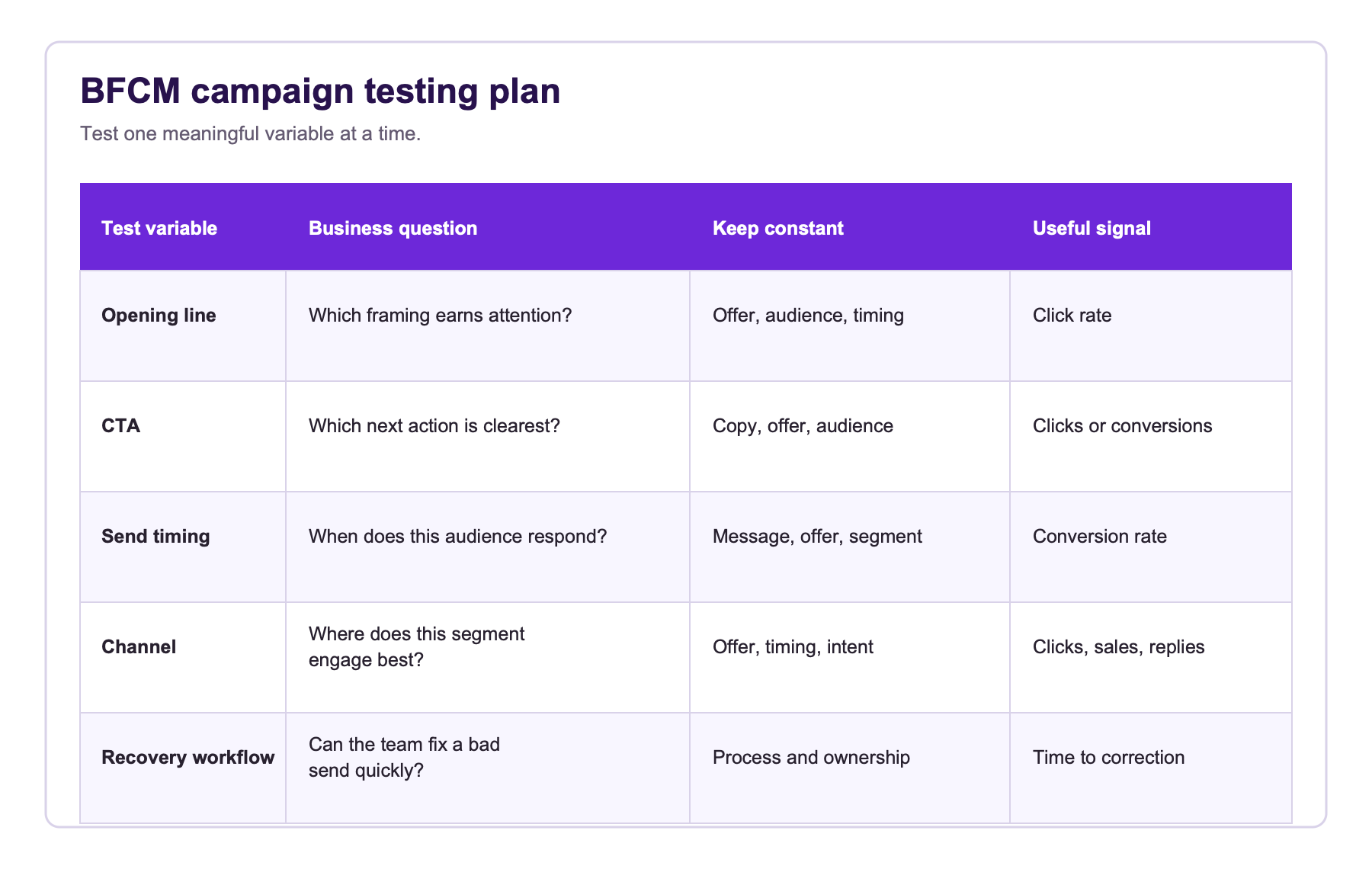
Test one variable at a time
A/B testing becomes much less useful when several things change at once. If one segment receives different copy on SMS in one country and another segment receives different creative on WhatsApp in another country, a performance difference cannot be attributed cleanly to any single variable.
The simplest rule is: one test, one question, one meaningful variable.
Test copy and CTA separately
If you want to know whether curiosity-led copy earns more clicks than a direct discount message, keep the offer, audience, CTA, and timing the same. If you also change the button language or destination, you no longer know which change caused the result.
The same applies to CTA tests. A short Black Friday SMS may work better with one clear action than with multiple competing links. If the test is about the CTA, keep the rest of the message stable.
Test timing against the same offer
Timing should be tested with comparable messages and audience segments. A launch send and a final-day reminder naturally behave differently because the customer context has changed. That does not make timing tests useless, but it means the team should define what it is trying to learn.
For example, a brand may test whether an evening reminder outperforms an afternoon reminder for the same offer, or whether a pre-sale announcement creates more qualified traffic before the launch.
Separate channel tests from market tests
SMS and WhatsApp can serve different audiences well, but channel comparisons are only meaningful when geography, offer, audience quality, and campaign purpose are reasonably controlled. If channel and market change together, treat the result as directional evidence rather than proof that one channel is better.
Match the message to its job in the sequence
One of the most common problems in holiday SMS marketing is using the same message logic at every stage. The best opener for an early announcement may be wrong for a final-day reminder.
An early message can create interest. It might lead with the product, a benefit, exclusivity, or curiosity rather than immediately forcing urgency. At launch, clarity becomes more important: what is available, why it matters, and where the customer should go.
As the deadline gets closer, urgency becomes more credible because the time constraint is real. This is where direct language such as "ends tonight" can make sense, provided the deadline is genuine.
The same principle applies to WhatsApp. Richer message formats do not remove the need for a clear purpose. Images, product context, or a more conversational format are useful only when they support the job of that message.
Keep the copy short enough to understand quickly, use a clear CTA, and make sure the destination matches the promise in the message. The campaign should feel like a sequence of purposeful touches, not repeated noise.
Build the recovery workflow before something breaks
Campaign planning usually focuses on the happy path: the message is approved, the link works, the audience is correct, and the send goes out on time. BFCM pressure makes the failure path just as important.
A broken link, incorrect promo code, wrong date, missing personalization field, or audience mistake can damage a campaign quickly. The operational advantage comes from knowing what happens next before the error occurs.
Define who monitors the send, who can pause or correct it, who approves the replacement message, and how quickly the team is expected to respond. Prepare simple correction language in advance so the team is not writing from scratch under pressure.
Trackable links are especially important. They make it possible to see whether recipients clicked and whether the destination is behaving as expected. They also help connect message performance to the action that matters, instead of judging a campaign only by delivery data.
A correction message should be clear and concise. Acknowledge the issue when necessary, provide the correct action, and avoid turning the explanation into a second long promotion. The goal is to restore the path to conversion while customer attention is still available.
Choose SMS or WhatsApp based on audience and market
Channel choice should follow customer behavior, consent, and campaign purpose rather than a belief that one channel is universally stronger.
SMS is often the simplest option when broad mobile reach, speed, and a compact call to action are the priority. WhatsApp can be a strong fit for audiences and markets where customers already use it heavily for brand communication and where richer or more conversational messaging supports the campaign.
The important thing is to test channel fit without confusing it with other variables. If a brand uses WhatsApp for one geography and SMS for another, the result can help shape the next test, but it should not be presented as a clean channel comparison.
Preference and consent also matter. A channel that performs well for one segment may feel intrusive or unfamiliar to another. BFCM is not the time to force customers into a channel relationship they have not established.
For teams using both channels, TopMessage Marketing Campaigns can support SMS and WhatsApp campaign workflows, segmentation, scheduling, testing, and performance tracking from one place. The product should support the strategy, not replace it: the team still needs to decide which audience, message, and timing deserve the send.
Measure, learn, and lock the plan before BFCM
A winning test is only useful if the metric matches the business question. High clicks can be encouraging, but they are not automatically better if sales stay flat or unsubscribe behavior worsens.
Choose the primary metric before the test begins. Depending on the campaign, that may be clicks, conversions, orders, revenue, replies, or unsubscribes. Secondary metrics can explain what happened, but the team should know which outcome decides the winner.
Use trackable links when the goal is traffic or purchase behavior, and keep campaign naming and attribution consistent enough to compare tests over time. When results are mixed, treat them as a signal for another test rather than forcing a conclusion.
Pre-BFCM testing checklist
- Which copy angle has earned attention from this audience?
- Which CTA produces the clearest next action?
- When should the launch, reminder, and deadline messages be sent?
- Which segments belong on SMS, WhatsApp, or both?
- Which links and conversions are being tracked?
- Who owns correction and resend decisions?
- Which metrics determine whether a test wins?
- Which findings are strong enough to reuse, and which still need validation?
That is the real value of pre-peak testing. A stronger BFCM SMS strategy is not built by predicting the perfect Black Friday message. It is built by removing avoidable uncertainty before the busiest part of the season begins.
FAQs
When should Black Friday SMS campaigns start?
There is no universal start date. Begin early enough to test the parts of the campaign that matter - copy, timing, CTA, tracking, and channel fit - and to build awareness before the busiest promotional period. The exact timing should follow your audience, offer, and sales calendar.
How many SMS messages should a brand send during BFCM?
There is no fixed number that works for every brand. A better rule is to give each send a specific job, such as pre-sale awareness, launch, reminder, deadline, or follow-up. Avoid repeating the same promotion simply to increase frequency.
What should teams A/B test before BFCM?
Test one meaningful variable at a time. Good candidates include the opening line, CTA, send timing, offer framing, or channel. Keep the other major variables stable so the result can actually guide a decision.
Should SMS and WhatsApp be compared directly?
They can be compared when audience, geography, offer, timing, and campaign purpose are controlled closely enough. If market and channel change at the same time, treat the result as directional rather than proof that one channel performs better.
Which metrics matter most for Black Friday SMS marketing?
Choose the metric that matches the business question. Clicks may matter for traffic tests, while orders, revenue, conversions, replies, or unsubscribes may be more useful for other campaigns. Decide the primary metric before the test begins.
What should a team do if a BFCM message contains a broken link?
Use a predefined correction workflow. Confirm the problem, fix the destination, approve a concise correction message, and resend quickly enough to preserve customer attention. Trackable links make detection and performance analysis easier.